
The governor had just made an elaborate presentation in defence of the central bank's decision to not to succumb to industry's demand for rate cuts in the mid-quarter policy.
The governor had just made an elaborate presentation in defence of the central bank's decision to not to succumb to industry's demand for rate cuts in the mid-quarter policy.

BSE Realty, Capital Goods and Consumer Durables indices were down by 3% each.
Three months on the job seem to have converted Reserve Bank of India Governor Raghuram Rajan from an inflation hawk to at least a pragmatist.

It will be the second Budget of the Modi 3.0 government and eighth straight Budget for Nirmala Sitharaman, rare in Indian polity.
The government and financial sector regulators buried their differences on the proposed Financial Stability & Development Council (FSDC) after Finance Minister Pranab Mukherjee offered the Reserve Bank of India governor a sweetener.
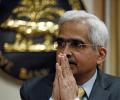
Uncertainty is emerging as the only certainty, said RBI Governor Shaktikanta Das as he emphasised on continued policy support at the December MPC meet during which members expressed concerns over spread of the Omicron variant of coronavirus, as per the minutes of the rate-setting panel released on Wednesday. After three days of deliberations, the six members of the Monetary Policy Committee (MPC) on December 8 unanimously voted for status quo on policy rates for the ninth consecutive time. At the meeting, the RBI Governor said risks stalking the global economy have amplified with rapid spread of the virus mutations, including the Omicron variant, leading to countries scrambling for restrictions.
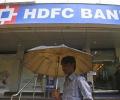
This is not for the first time that the customers of the bank have faced service outage. In fact, the bank has been penalised by the Reserve bank of India (RBI) for two major outages in the past. In December, the RBI temporarily barred HDFC Bank from launching new digital banking initiatives and issuing new credit cards after taking a serious view of service outages at the lender over the last two years.

Excerpted from the inaugural address by Dr K C Chakrabarty, Deputy Governor, Reserve Bank of India, at the IBA-DSCI Conference on 'Security Framework in Indian Banks', in Mumbai on April 26.

Banks have raised concerns over the new international trade settlement in rupee, fearing that facilitation of such a mechanism could result in them facing the ire of economic sanctions by the West, people aware of the matter said. Large banks with overseas operations have sought clarity and assurance from the Reserve Bank of India (RBI) that they will not be targeted with sanctions for facilitating rupee trade with a sanction-hit country such as Russia. The present payment mechanism is a shift from earlier such arrangements, like the one with sanction-hit Iran, which involved banks facilitating settlement of international trade that did not have business in the sanctioned nation.

The 42-year-old Acharya's appointment for a three-year tenure was cleared by the Appointments Committee of the Cabinet.

Reserve Bank of India (RBI) governor Raghuram Rajan says global markets are at risk of a "crash" should investors start bailing out of risky assets created by the loose monetary policies of developed economies.

'People who come from IMF-World Bank backgrounds have no dynamism at all,' Subramanian Swamy said.

India's banking sector, dominated by more than two-dozen state-run lenders, has been hobbled by its highest bad-loan ratio.

"I'm taking a minute to respond... I do respect Raghuram Rajan as a great scholar who chose to be in the central bank in India at a time when the Indian economy was all buoyant," Sitharaman said during the lecture organised by the Deepak and Neera Raj Centre on Indian Economic Policies of the Columbia University.
Reserve Bank Governor Shaktikanta Das said on Monday that fair and impartial auditing is essential for a resilient economy as it instils confidence among citizens. Addressing officers at the National Academy of Audit and Accounts, Das said that audit is important for the country as public expenditure decisions are based on these reports. Observing that there is a need to improve the quality and depth of audit, he said the Reserve Bank has taken a host of steps in consultation with the Institute of Chartered Accountants of India (ICAI) for improving the audit of banks and financial institutions.

'Banks are being encouraged to lend instead of parking their resources with the RBI and earn risk-free interest income,' points out Tamal Bandyopadhyay.

Finance Minister P Chidambaram at the Group of 24 Meeting of the Ministers at the International Monetary Fund headquarters in Washington, DC on Thursday.
RBI Governor Shaktikanta Das on Thursday said financial inclusion will continue to be a "policy priority" for the central bank to make the post-pandemic recovery more equitable and sustainable. The Reserve Bank of India will very soon be coming out with the first financial inclusion index, which will assess progress in terms of access, usage and quality, Das said, while speaking at the Economic Times Financial Inclusion Summit. It is the responsibility of all stakeholders to ensure that the financial ecosystem (including the digital medium) is inclusive and capable of effectively addressing risks like mis-selling, cybersecurity, data privacy and promoting trust in the financial system through appropriate financial education and awareness, he added.

Reserve Bank of India Governor Urjit Patel on Saturday exhorted banks to reduce their lending rates to push credit demand in laggard segments, saying banks have benefited from influx of low-cost deposits and its previous repo rate cuts.
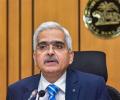
The RBI raked in a massive net income gain from foreign exchange currency sales as a buffer for the rupee during tumultuous geopolitical upheavals last year owing to Russia's invasion of Ukraine.

The Reserve Bank of India on Friday decided to keep benchmark interest rate unchanged at 4 per cent but maintained an accommodative stance even as the economy is showing signs of recovery after the second Covid wave.
A few market and economic indicators have begun looking up, thanks to what many term the 'Rajan effect'.

'Data-dependence means you can raise or drop rates. The present stance is only for raising rates.'

Maintaining 4 per cent inflation is appropriate for India as targeting a lower rate could impart deflationary bias to the monetary policy, said a Reserve Bank paper. Under the current dispensation, the RBI has been mandated by the government to maintain retail inflation at 4 per cent with a margin of 2 per cent on either side. The paper, authored by RBI Deputy Governor Michael Debabrata Patra and another official Harendra Kumar Behera, has found a steady decline in trend inflation to 4.1-4.3 per cent since 2014.

Arundhati Bhattacharya is a strong contender for chairperson post, after Pratip Chaudhuri retires in September.

While the fiscal year has just begun, any windfall surplus will be welcomed by the government as it bids to meet the fiscal deficit target of 5.9 per cent of GDP, amidst lack of clarity on exactly to what extent will recession in the West impact India's trade and tax collections.
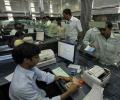
Mergers to create at most six state banks
Subbarao also warned of attrition in PSBs, saying, "PSBs will lose talent to the private sector."
Concerned over growing litigations against banks and high-handedness of recovery agents, the Reserve Bank on Tuesday issued strong warning to banks to check such practices or be barred from engaging such services.
Rajan also expressed hope that a stable government after the Lok Sabha elections will continue the broad fiscal policies of the current regime and India may finally get the Goods and Services Tax, an ambitious indirect tax reform measure.

Dr T V Somanathan is the first finance secretary to be appointed Cabinet secretary since 1985. His appointment at this juncture seems to carry much meaning for the forthcoming trajectory of reforms and restructuring of India's steel frame.

Reserve Bank of India Governor Raghuram Rajan took charge of India's central bank when the rupee seemed to be in a tailspin while the country was facing runaway inflation.
The Reserve Bank of India has instructed banks to introduce zero-balance account to enable the masses to avail banking facilities.

The appointment will be made by Prime Minister Narendra Modi in consultation with Finance Minister Arun Jaitley.

The decision by the Reserve Bank of India to introduce a unified regulatory framework on connected lending for all the regulated entities (RE) is expected to reduce the influence of business conglomerates in the Indian lending space, said bankers and experts. "Connected lending pertains to lending to related parties within the same business group. "While the RBI might appear more agreeable to allowing business conglomerates to own banking licenses, it deems it crucial to bolster regulations that would prevent conglomerate-owned banks from gaming the system," said Shivaji Thapliyal, head of research and lead analyst, YES Securities.

Reserve Bank will have to constantly re-assess the "dynamic and fast changing situation" and tailor its actions accordingly, Governor Shaktikanta Das said during the recent meeting of the Monetary Policy Committee (MPC) which decided to maintain status quo on key interest rate. According to the minutes of the six-member MPC meet released by Reserve Bank of India (RBI) on Friday, the five other members had also expressed a similar opinion amid the ongoing Russia-Ukraine conflict's impact on the global and domestic economies. MPC, which held its meeting from April 6-8, unanimously decided to keep the borrowing costs unchanged at a record low for the 11th time in a row in a bid to continue supporting economic growth despite inflation edging higher in the aftermath of Russia-Ukraine conflict.

'The BJP lacks a credible mass leader who matches Mamata Banerjee's popularity.' 'Given the division of votes among Opposition parties, the West Bengal government's dole-giving strategy, and the consolidation of the poor, significant sections of scheduled caste groups and Muslim minorities behind the ruling party, it will be difficult to dislodge the Trinamool from power.'
The new Guv needs to focus on structural inflation problems.
